

|
|

Page 1 of 2:
Whilst
individual bonsai specimens can take a number of years of training
to create a strong visual image, well designed group plantings
can be far more instantly satisfying.
Group plantings replicate a number of trees growing together in
a copse, wood or a forest and reflect the interplay between the
trees and their branches as they compete for light and nutrients.
Successful groups can be created using young, thin trunked plants
with little taper, that would otherwise have little use as individual
bonsai specimens without considerable training. Successful group
plantings are not so reliant on the material used; it is the artists
creativity that makes for satisfying results.
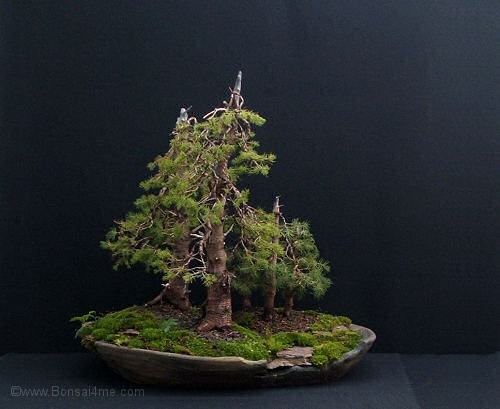
Picea
Group Planting by Harry Harrington
OBTAINING TREES FOR GROUP PLANTINGS
Most species can be used for group plantings, though species that have naturally upright, branching habits are preferable. Small leaved species are most suited to small and medium groups whilst coarse growing or large-leaved species suit taller plantings.
Particularly recommended are; beech (Fagus), birch (Betula), Cryptomeria, elms (Ulmus or Zelkova), hornbeam (Carpinus), juniper (Juniperus), larch (Larix), spindle trees (Euonymous) and maples (Acers).
Group plantings are usually composed of one species only as this creates a more natural look and is far easier to style successfully. It is possible to include more than one species in a group but this not only disrupts the image and scale but can also cause problems due to the differing cultivation requirements of each species that is used.
When purchasing trees for group plantings, it is necessary to obtain trees that have more slender, upright shapes preferably with a number of short branches emanating from the top 2/3 of the trunk. It is not necessary to have tapered trunks though trunks with a distinct inverse taper are still unsuitable. Trees should have a range of heights and trunk thickness to enable the creation of depth to a group planting. Any number of trees from 3 upwards can be used though it is highly preferable to use an odd number unless the group consists of 15+ trees. It should be noted that with plantings of 5 trees or less it is harder to convey a feeling of depth to the work. An even number of trees in a group planting is supposed to be unlucky, it is also more difficult to arrange successfully. Always have a greater number of trees available to you than will be required so you are not restricted in your design as you actually construct the planting.
Preferably trees that are being prepared for a group planting should have small, compact rootballs to enable easy positioning in the container.
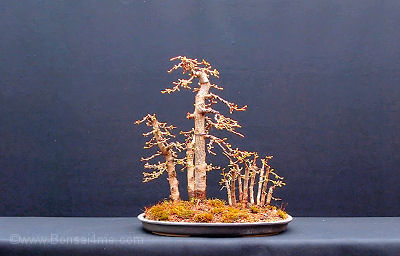
Japanese Larch Group Planting by Harry Harrington
POTS FOR GROUP PLANTINGS
An impression
of space is very important when creating group plantings and a
large shallow container contributes to this sense of space. Deep
containers need to be avoided unless the trees used in the group
planting have thick trunks. A shallow container should be no deeper
more than twice the width of the thickest trunk to be effective.
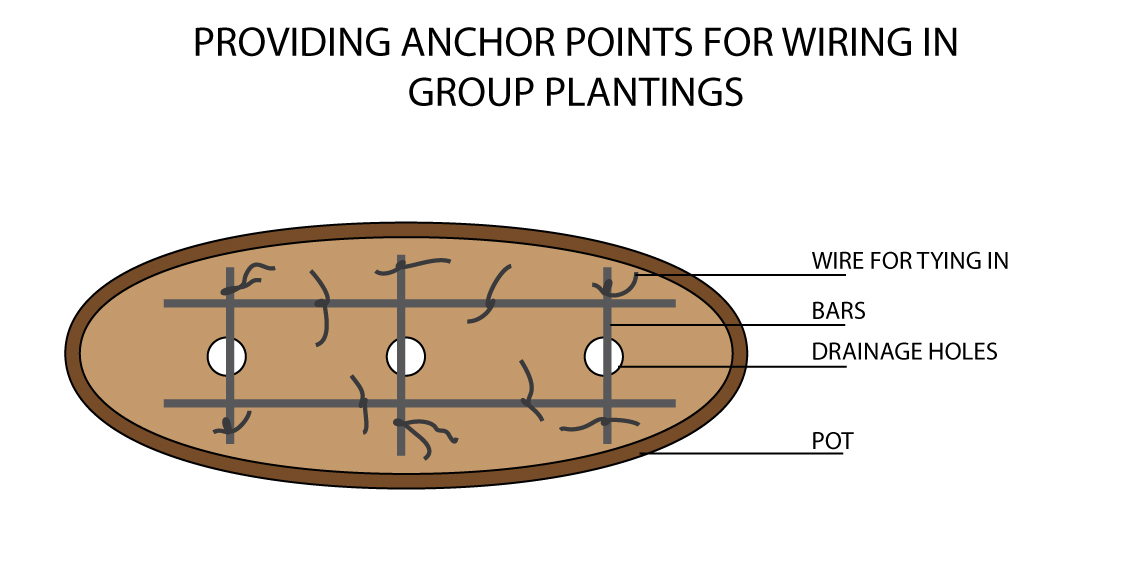
It is very important that after positioning your trees in the
group planting they are unable to move, as this can damage fine
roots as they start to spread out into the compost and will also
destroy the image you have created. To anchor your trees into
position until their roots have inter-twined and are able to hold
still themselves, anchor wires must be used. When preparing the
pot, bars of bamboo or sticks are tied into a frame at the base
of the pot; anchoring wires can be attached to this frame where
necessary. When repotting the group-planting in 2 or 3 years time,
the roots of all the trees should have fused together and the
anchoring wires and frame can be cut out.
Instead of a pot , slabs of rock or slate are sometimes used and
with care a very natural look of trees growing in the mountains
can be achieved. Slabs of stone can be prepared for rock plantings
by drilling drainage holes in the rock to allow excess water to
run off. Anchor wires are glued firmly in position on the surface
of the rock and are used to hold trees in position. A 'wall' of
clay mixed with peat is placed around the edge of the slab to
keep the compost from running off.
DESIGNING
A GROUP PLANTING
A bonsai group
planting creates an illusion of perspective by using a number
of visual tricks often used in drawings and paintings. Perspective
is created by drawing the eye to a number of focal points that
subconsciously fools the viewer.
Tall trees are positioned at the front of the pot and smaller
trees toward the back create a feeling of greater depth than the
actual width of the container.
Trees in nature vary in height and trunk thickness and this should
be reflected in your design, the tallest trees should have the
thickest trunks, the smallest trees the thinnest. Symmetry in
group planting will always draw the eye and should be avoided,
trees should be planted at unequal distances from each other and
according to height.
A sense of perspective can also be created by creating sub-groups
of trees so that the entire group will consist of 2,3 or more
smaller groups. For the viewer this also leads the eye through
the trunks of the planting to the smallest trees at the back,
re-enforcing the sense of perspective.
The silhouette of the planting as a whole should be triangular
with the two sides from the apex tapering away at different angles.
If the silhouette of the back ground trees is kept simple, attention
is drawn to the trunks and branches of the trees at the front,
the rear trees become less distinct and therefore further away
in the eye of the viewer.