

|
|

Page 1 of 2:
Many bonsai
enthusiasts are familiar with the Japanese terms ‘Jin’,
(meaning a dead branch, stripped of bark) and Shari or Sharimiki
(an area of the trunk stripped of bark to create a deadwood
feature).
This article describes the technique and purpose of creating
‘Uro’, or to give it’s literal meaning, ‘to
carve out’.
Jin are
often used on Pine, Juniper and other coniferous bonsai to show
where branches have died and dried out, eventually becoming
bleached in the sun. This is used on coniferous bonsai to create
an illusion of age and to replicate a natural phenomenon that
occurs in nature on field-growing trees.
However, though there are a few exceptions, jin are not typically
suitable for deciduous and broadleaf species. Dead branches
on field-growing deciduous trees do not dry and remain on the
tree as with conifers. Instead they quickly rot and fall from
the trunk.
For deciduous bonsai, jin not only look unnatural and unrealistic
to the discerning eye, but they can be very difficult to preserve.
As with their field-growing counterparts, jin on deciduous bonsai
rot easily.
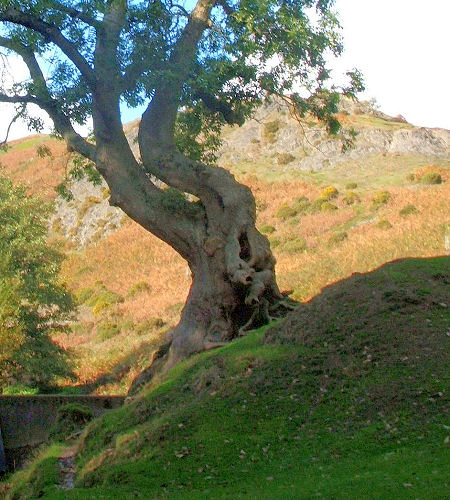
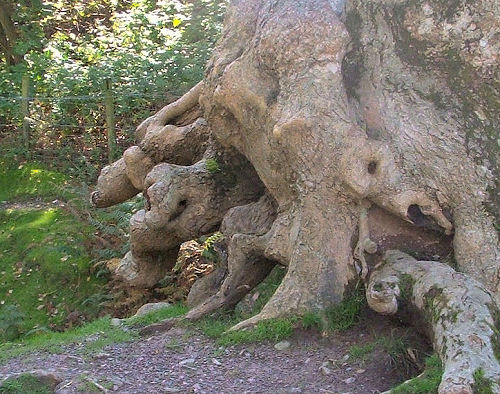
This old
Mountain Ash shows many old Uro at its base. In the past, low
branches, possibly minor trunks or even roots have died and
rotted, falling away from the tree leaving wounds in the trunk.
Smaller wounds (caused by the death of small branches) will
have eventually healed over with bark. But, as the tree has
continued to grow over the years and the wood inside the larger
wounds has rotted away, hollows in the trunk have formed.
This is essentially what we try to imitate when creating a Uro on a bonsai.
Pruning large branches on deciduous bonsai
When pruning
away branches on coniferous bonsai, it is common to leave a small
stub that can then be jinned and lime-sulphured. One reason for
using this technique is that if the branch is pruned flush to
the trunk, the resulting wound will look ugly and fail to heal
over (with new bark) for many years, if at all.
When pruning faster healing deciduous branches, it is common to
prune flush to the trunk, hollowing the wound very slightly.
However, some deciduous (and broadleaf) species do not produce scar tissue readily and are very slow to heal over wounds, resulting in an unnatural flat scar. In other situations, wounds can be so large (particularly after trunk chopping) that it is unrealistic to expect the wound to heal over in less than 10, 20 or more years. This is where the Uro can be used to great effect.
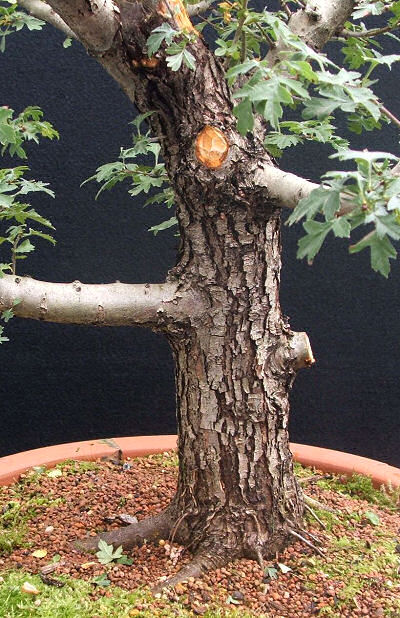
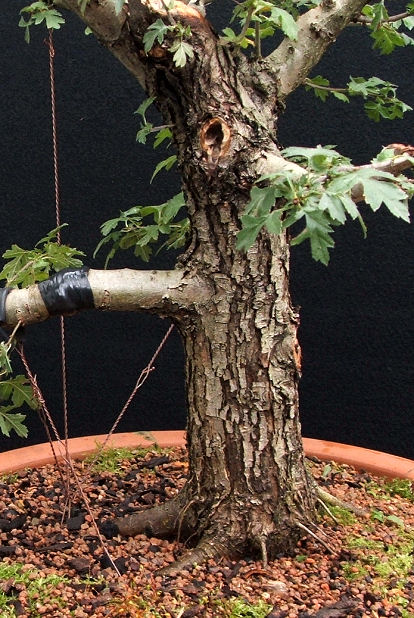
This Hawthorn has had a branch of around ½”-1" removed from the front of the trunk. The branch was cut flush to the trunk and slightly hollowed as is usual with deciduous species. However, the resulting wound/scar will fail to heal for at least 5-10 years or possibly longer. When healed, the scar tissue will take many more years to develop the mature bark of the surrounding area.
Rather than leave the wound as it is in such a prominent position (at the front of the tree), a uro is created. The wound is made into an interesting deadwood feature.
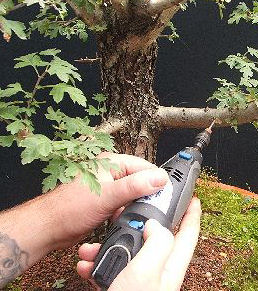
Creating a Uro
Creating a
Uro is very simple. An ordinary drill bit or router bit is used
in a drill, Dremel or die grinder and ‘plunged’ into
the wound to make a hollow. Shown above is the author using a
dremel fitted with a small drill-bit.
An almost random shape to the carving creates the most natural
appearance. The only rule would be to try to avoid the uro being
perfectly (and therefore artificially) round. Ensure that the
uro is not just a uniform hole carved to a uniform depth.
Treating the Uro
Immediately
after the creation of a uro, the colour of the wood is stark and
bright. If left to the elements, the wood will weather and take
on a more natural hue over the coming months.
If a more immediate solution is required, lime-sulphur mixed with
black acrylic paint or India Ink can be used to produce a darker,
subtler colour. Do not use pure lime-sulphur as the stark white
of the wood looks very unrealistic.
Protecting the Uro
Depending
on the hardness of the wood, the position of the uro and its exposure
to moisture, the wood inside the uro will start to rot at some
point in the future. This will bring no harm to the live parts
of tree.
However, if there is a need to ensure that the wood does not rot
in the future, treat
with a wood-hardening product. Some tree species such as (but
not limited to) Birch, Fuchsia and Bougainvillea have very soft
wood that is especially prone to rotting if exposed to moisture.
Do not create uro’s on these species if there is any possibility
of the wound healing over naturally (and therefore protecting
the wood naturally).
Creating a Uro: General comments
Creating a uro is a very straightforward technique, however, it is much more difficult to learn how to make the correct use of a uro aesthetically.
Before creating a uro on a bonsai, always consider whether it would be appropriate for the tree.
I use uro extensively on yamadori (collected) Hawthorn where it is often necessary to remove large branches but the production of scar tissue and wound healing is poor. In these situations, the use of a uro is essential to avoid the future bonsai being covered in ugly unhealed wounds.
Ultimately,
the strong, masculine qualities of a Hawthorn are well suited
to this technique.
However, I would not consider creating uro on a tree such as an
Acer palmatum that is a much more graceful and feminine species
with a strong ability to heal large wounds successfully.
Once a wound has been successfully converted to a uro, there is no going back, the wound will never be able to heal over smoothly.
Finally, it should be noted that creating a uro is not the only way of hiding a large wound on deciduous and broadleaf species though it is my preferred method. Techniques involving painting large scars and wounds with acrylics or hiding wounds (on rough barked species) with pieces of bark are also possible.