

4.9 out of 5.0 stars on Amazon"Upon finding that I work as a professional bonsai artist, many people will remark that they once had a bonsai, but it died and with some regret, they gave up". Based on the Bonsai Basics section of the hugely successful Bonsai4me.com website and an e-book of the same name, 'Bonsai Basics: The Foundations of Bonsai', written and developed over the past 15 years is out now! All copies are signed by the author. |
Page 1 of 2:
Most species of bonsai and nearly all temperate climate woody plants require the cold. During the Autumn, as daylight hours become shorter and temperatures drop, trees react by hardening up their immature growth. Stem tissues begin increasing their levels of sugars and carbohydrates which by the time the first frosts arrive, act as an antifreeze to ensure that the plant itself will not freeze. Deciduous species lose their leaves to reduce moisture loss and all growth stops for 4 or 5 months. (Coniferous species have thin, waxy needles that reduce transpiration to a minimum and this allows them to stay evergreen).
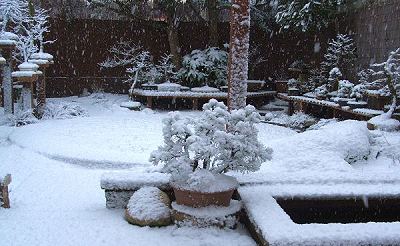
My bonsai after a snow storm in March 2006
DORMANCY
Eventually as winter arrives, trees have completed their natural
defensive system against the cold of winter; dormancy. In the
Spring as temperatures rise, new buds on the trees will start
to extend and unfurl their first growth in Spring, completing
an entire years' growth cycle.
Some bonsai beginners feel that their trees may perish if subject
to the harsh conditions of the winter months and bring their trees
indoors to 'protect' them. This continuation of heat and light
through the winter prevents dormancy in temperate trees. The resulting
continual growth throughout the year goes against the trees' internal
clock which is requiring a dormant period, the clock can be tricked
to an extent; the tree will continue to grow inside. It may even
grow continuously for as long as two years after which, whatever
the season or conditions, deciduous species will drop all leaves
and evergreens will stop all growth. This out of season dormancy
usually results in very sickly trees and even death.
.jpg)
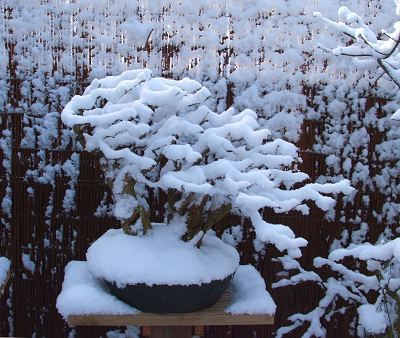
English Elm bonsai during the Winter
HOW LONG A DORMANCY DO TREES REQUIRE?
For areas with mild winter temperatures, providing a natural winter
dormancy can be difficult;it should be noted that all temperate
woody plants require a dormant period where temperatures drop
to less than 10C continually for a period of between 260 hours
and 1000 hours (depending on individual species). This equates
to a dormant period of between 11 days and 42 days of continual
sub 10°C temperatures.
TROPICAL AND SUBTROPICAL BONSAI
The only exceptions to this need for dormancy are tropical and
subtropical species. These are outdoor trees only during the warm
summer months in many temperate areas of the world. To keep them
outside during the winter would be fatal. Tropical and subtropical
trees have very modest dormancy requirements and in their native
habitats are capable of continuous growth all year round at 20°C
or above.
For this reason tropical and subtropical trees are resilient to
indoor growing conditions during the Autumn, Winter and Spring.
The truth is that nearly all temperate woody species are reliably
hardy down to -10°C (15F). Below this temperature all that is
required is some protection for the root system which is not as
frost hardy as the top growth. To become reliably hardy to these
temperatures, trees must fully harden up in the Autumn by being
grown outside. Trees are able to survive sub-zero temperatures
by virtue of being dormant. Trees that are purchased during the
winter should be kept in similar conditions to those that they
had been kept in by the retailer, even if this was indoors. To
put a tree outside in the middle of winter when it has previously
been grown indoors and is still active would kill it.
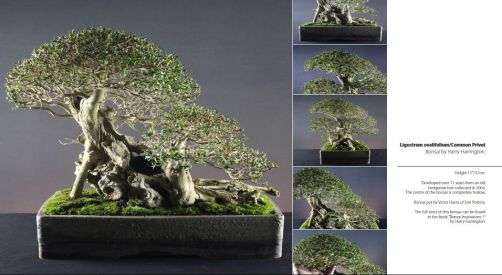
A Privet (Ligustrum) Bonsai
|
|
THE EFFECT OF FREEZING ON BONSAI
The rootsystems of our bonsai are the most susceptible part of
the tree to damage from the cold. In nature, a trees roots' are
buried into the ground and are rarely subjected to freezing temperatures.
Whilst the surface of the ground may freeze, this will only affect
the top few inches of the soil. Below this the cold is unable
to penetrate deep enough to freeze and the trees' rootsystem remains
unaffected by the above ground temperature. Bonsai however, have
their entire rootsystem above ground level in an often shallow
pot where the soil is easily affected by prevailing air-temperatures.
The top growth of trees in nature however, is subject to the full
force of winter and is able to withstand temperatures far lower
than the rootsystem ever could. Though the rootsystem hardens
up in the Autumn, it is to a lesser extent than the topgrowth.
Damage to topgrowth only usually occurs when the ambient temperature
rises during the day whilst the water in the ground or pot is
still frozen. This situation can often arise in greenhouses during
the winter and also outside in areas where there are large fluctuations
in temperature between day and night. As temperatures rise the
leaves start to transpire but the roots are unable to take in
replacement water from the frozen soil, causing the top growth
to dry out, resulting in dieback. This problem can also be aggravated
by wind which also results in moisture loss from leaves and shoots.
When we see the soil in our bonsai pots is frozen in winter, it
is easy to think likewise that the tree itself is frozen. In fact,
it is the water in the soil that is frozen, not the soil and importantly
nor the roots of the bonsai itself. If the roots of the bonsai
were to freeze, it would be fatal.
During the Autumn, the tree stores a mixture of sugars, sugar
alcohols and proteins that act as an antifreeze, so whilst the
water in the soil may have crystalised into ice, the tree itself
is still fluid. It is not until the temperature of the soil drops
below -10°C that there is a threat of the rootsystem freezing.
There is a variation in frost-hardiness between different species
of trees and naturally shallow-rooted trees such as Azaleas are
hardy to far lower temperatures than species that are typically
deep-rooted. Some species such as Trident Maples and Magnolias
are more susceptible to frost damage and protection from temperatures
warmer than -10°C should be given.
When outside air temperatures drop below -10°C, the pot needs
to be afforded some protection to stop the temperature of the
soil dropping to the same level.
|
|