

|
|

Part One : Page 1 of 2
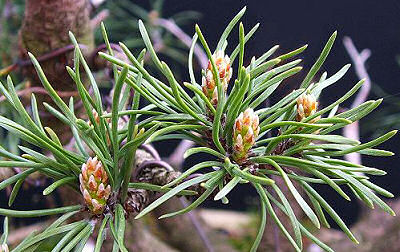
Mugo Pine branch with standard coiled wiring
The easiest and most common way to bend any branch into position is to coil it with aluminium or copper wire, manipulate it by hand and with the aid of the coiled wire, it then remains in its new position. (Wiring article)
In some situations, prior to applying the wire it is useful to protect the bark and the wood by using raffia (or similar) to stop the branch cracking or to stop the bark separating from the wood. (See Article)
However, with all tree species, there is a point where a branch is too thick to physically bend with just the strength of your fingers or there is a danger of the branch (the wood) snapping. For some tree species this can mean a branch as thick as 2.5cm/1" or more and for some species with brittle wood, as thin as just .5mm
|
Guy Wires
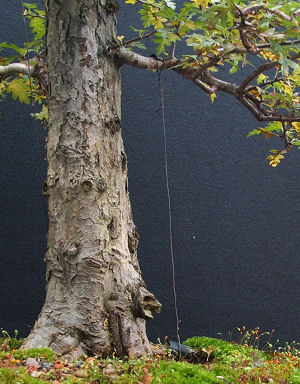
Guy wire anchored to a thick root using a single strand of 1mm wire to bring down a Hawthorn branch.
The
first technique worth covering in this article is the use of
guy wires. Once the thick branch has been bent (either by hand
or by using one of the techniques described in this article),
it needs to be held into position until it sets. A piece of
wire is attached from the newly bent branch to an anchoring
point to create a guy wire. The guy wire simply stops the branch
returning to its original position.
Various anchor points can be used; another branch on the tree, a jin, a hole through the side of the (training) pot, a thick surface root or even a small brass screw or hook, inserted into the trunk.
A guy wire made from copper wire is always preferred over aluminium for it's greater strength and lack of elasticity. Aluminium guy wires can begin to stretch over time, allowing the branch to move slightly out of position.
For aesthetic reasons, try to use the thinnest gauge wire possible. For most situations, 1mm copper wire is adequate though 1.5mm can be necessary when the guy wire requires extra strength.
Guy wires are an incredibly useful bonsai technique. However they do have limitations; guy wires have no control over the shape or movement of a branch and less control over it's precise position. The guy wire can only pull a branch in one direction whereas coiled wire allows much greater control and freedom of manipulation along the entire length of a branch. For this reason guy wires are generally limited to 'holding' branches into position and are used in addition to coiled wire techniques rather than replacing them.

The upper branch of this Acer palmatum has been notched and is held into position with a guy wire tourniquet. Electrical flex has been used to protect the bark.
If a guy wire is simply tied around the branch, it will quickly become embedded in the bark so some protection fis required. I use old electrical flex with the wire stripped out and the bonsai wire threaded through the casing. Rubber padding can be used but has a tendency to slip around as the guy wire is fitted to the branch.
Branches that have been bent using coiled wire techniques set
into position more quickly than they will with guy wires. However
as long as some cushioning is provided (as described above),
guy wires do not cut into a branch as it grows and so can be
left in position for a longer period of time. (For this reason
guy wires are also very useful for pulling the branches of field
growing trees into position without the risk of deep wire scars).
>>Bending ‘Thick’ or Brittle Bonsai Branches Part One: Page 2 of 2