|
BENDING BRANCHES WITH RAFFIA
|
Some tree species
have growth that is pliable enough for branches 1" thick
or more to be successfully wired into a new position. Slight adjustments
in position can be made using straightforward wiring techniques.
However, with more severe repositioning, damage can occur to the
branch and the bark, from both the wire that is used, and the
degree of turn put into the branch itself.
|
|

The tree that is used in this photo series is a
Fagus sylvatica/ European Beech. Beech have fairly pliable branches,
but they also have thin bark which is marked easily by wire. Similarly,
most coniferous trees, such as Junipers and Pines, have pliable
branches on which this technique can be used.
On
the other hand many
deciduous species, have brittle growth, that if bent too far, will
snap. It is very important that great care is taken that branches
are not broken from the use of over-zealous wiring.
The branch in the foreground of this picture is
approximately 1" thick; it is growing out towards the front
of the tree though it actually emanates from the right-hand side
of the trunk. It is necessary from a design point of view, for the
branch to be moved so it grows to the right of the tree.
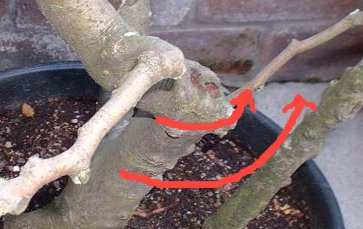
The red arrows in
this picture indicate where the branch is to be moved to. When
the branch is moved by hand towards its new position, there is
only moderate tension in the branch; it will however be difficult
to hold into place with just wire alone.
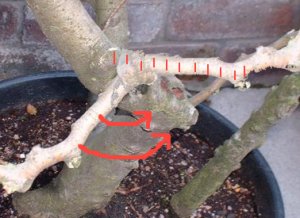
In
this picture, the intended new branch position has been digitally
super-imposed; though pliable, there are still a number of problems
that could occur. The bark on the outside of the bend will be
stretched in order to allow the branch to move; it is important
that any small breaks in the bark, (indicated by the straight
red lines) are supported, and encouraged to heal as rapidly as
possible.
If
the stress along the outside edge is allowed to concentrate on
one point instead of being spread over a larger area by raffia,
it is likely that the point of stress
could open and snap the branch.
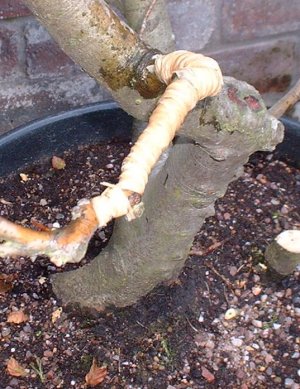
To protect the bark,
ensure that the branch is protected and strengthened, raffia is
wound around the branch.
Raffia is a reed-like
plant material commonly found in most garden centres, it is soaked
in water for 30 minutes and then carefully wound tightly, around
the length of the branch. In this case, 4 layers of raffia are
used. When applied wetted, raffia can be placed in single flat
layers; dry raffia is far more difficult to manipulate. As the
raffia dries, it will also shrink and tighten slightly, giving
the branch more support.
As well as protecting
and strengthening the branch whilst it is wired, the raffia also
stops the bark, and any small fractures, from drying out which
will ease healing.
After wrapping with
raffia, two lengths of wire are then applied to the branch; these
will not be able to stop the branch returning to its original
position on their own, but will again, diffuse the stress of the
bending across the length of the branch.

Finally, the branch
is moved very slowly into its new position; while doing so, it
is important to listen out for the sound any sharp 'cracks' as
the branch is moved. Cracking-sounds indicate that the wood inside
the branch is breaking and no further movement should be applied.
If there are any
doubts as to whether the branch will tolerate further bending,
it is better to secure in its current position and allow time
for the branch to adopt its current position before further movement
is applied.
To ensure that the
branch is held in its new position, a guy wire is applied from
the branch itself to another nearby branch.
The tree and this
branch in particular, will now be encouraged to grow strongly
through the next few months to allow the branch to heal and set
in its new position.
|
UPDATE
October 2005
Since originally
writing this article 4 years ago, I have stopped using raffia
when creating severe bends in trunks and branches. Though raffia
is the traditional method for providing protection and is without
doubt a viable option, I have found plastic tape is a better product
to use.
|
| |
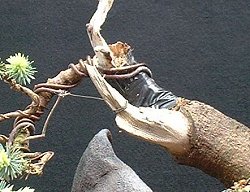
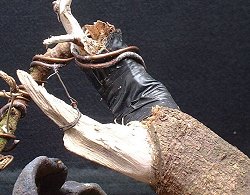
In this image
you can see that ordinary black insulation tape has been used to
protect the trunk prior to bending.
The first layer
of tape is wound with the sticky-side facing outward so that the
adhesive does not stick to the bark; the tape is then wound around
the branch with the sticky-side facing inwards.
The result is
a strong level of protection using a cheap and easily available
material (compared to raffia). Application is even more straightforward
than using raffia and removal after the branch has set is also much
easier.
The colour of
the insulation tape is also less obvious than the raffia (though
raffia can be dyed to a more appropriate colour prior to application).
|
There are
other products that can be used as well as insulation tape; many
enthusiasts are now using a product called 'Vet Wrap', a type
of elasticated bandaging.
If you decide
to try an alternative to traditional raffia, ensure that the material
you use is low-tack to aid easy removal. Make sure that the product
is strong enough to bind the branch tightly but importantly, also
has a degree of elasticity.
|
|
Related:
Bending Thick
or Brittle Branches Article Series
|
Copyright
© 2005 Bonsai4me. All
rights reserved. Reproduction in whole or in part in any form or medium
without permission of Bonsai4me prohibited.
Back
Home |